30 years of providing air ambulances for the sick
On 1st May 2024, the Flight Coordination Centre in the Air Ambulance Service will celebrate its 30th anniversary.
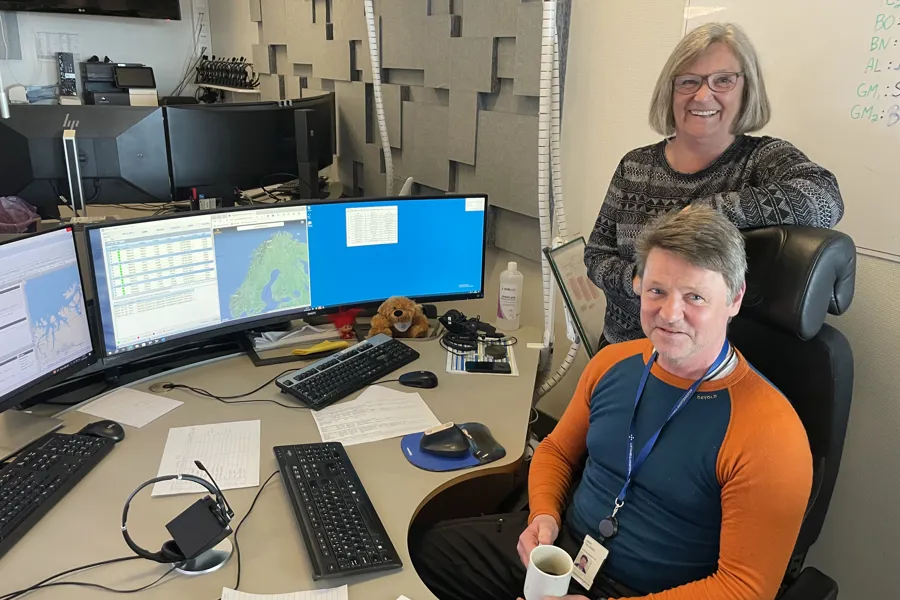
Photo: Elin Åsbakk Lind, Luftambulansetjenesten HF
Twenty-four hours a day, seven days a week, the 13 employees (including management) at the Air Coordination Centre (FKS) in Tromsø work to provide air ambulances for sick patients across the country.
The ten air ambulances are stationed at seven bases, and patients are always flown to the hospital that can provide them with the appropriate treatment. The challenge is to get all patients to their destinations quickly, safely, and efficiently.
Requires Systematic Approach
At the same time, FKS must monitor the readiness of air ambulances and ensure that aircraft are available for urgent needs, as far as possible. This is particularly important in Northern Norway, where the planes handle many emergency missions. It requires good planning skills, systematic approaches, effective communication, and creative solutions.
Jørn Tollånes and Siv Nordmo are on duty when we visit FKS on this day. The Air Coordination Centre is currently located in the same premises as the AMK Centre of the University Hospital of Northern Norway, but they coordinate all of the country’s air ambulances.
Jørn and Siv say it is a quiet day; nevertheless, they have eight out of ten air ambulances on missions, and it is barely past half past eleven in the morning.
Emergency Missions Come In
Right next to them sits the operator at MKA (Medical Coordination Air Ambulance). They are the ones who relay the missions that require air ambulances.
- We have an emergency mission in Alta; a stroke patient needs to go to Hammerfest, comes the message from MKA.
- Received, Jørn acknowledges and immediately relays the mission to the crew at the base in Alta via the emergency radio link so they can begin preparing for the urgent mission.
Then it is time to start working on flight plans that must be approved by Eurocontrol in Brussels, including an alternative airport, weight of the aircraft, passengers, and expected departure time. All of this must be done by the air coordination centre within ten minutes, and the crew in Alta must be ready in the aircraft within 20 minutes.
Next, arrangements must be made for fuel, de-icing in winter, and snow clearing must be ordered, and sometimes airports that are closed need to be opened for the air ambulances to take off and land.
Loves His Job
Jørn has worked at FKS for 28 of the 30 years the centre has existed. When he started, they planned flight routes on paper, and calls were made using pagers. Today, the tools and frameworks are entirely different, and although there can be tough days filled with seriousness, he still loves his job.
- It is solely the good stories that I remember, says Jørn.
He remembers those stories almost in detail. The stories where the Air Coordination Centre, despite challenges with weather, distances, and time, managed to get air ambulances to the benefit of those we are here for: the patients.
Like the time they transported a man south who had severed his fingers, and they suddenly received information that the fingers had been found, and if they were transported quickly to the patient, they could be reattached.
But no air ambulances were available.
Much the Same After 30 Years
The first head of the Air Coordination Centre and the one who started the centre in 1994 was Lars Erik Jamtli. He came from the Air Force and had a year to prepare for the launch alongside doctor Mads Gilbert, who was responsible for the medical aspect.
Most of the procedures and routines they established back then still apply today.
- It is a confirmation that the work we did back then was good work, says Jamtli.
Photo: Elin Åsbakk Lind, Luftambulansetjenesten HF
Jamtli led the centre for three years before returning to the Air Force in 1997.