We recommend that you upgrade to the latest version of your browser.

When time is of the essence

What happens when you are seriously injured or ill from the moment you call 113 until you arrive at the appropriate treatment facility? You encounter one or more parts of the emergency medical chain. The chain consists of a number of highly skilled professionals, resources, and measures. Together, they ensure that you receive help when it is most urgent.

Elin Åsbakk Lind
Published 4/30/2026
Ryggen av luftambulanse-crew med utstyr gjennom sykehuskorridor

Doctor, rescue worker, and pilot from the ambulance helicopter in Trondheim are on their way out with an intensive care patient. However, the emergency medical chain consists of more than just air ambulance.

The emergency medical chain consists of, among other things, general practitioners, municipal out-of-hours services, and out-of-hours service centres, the health enterprise's emergency medical communication centre (AMK centre), ambulance vehicles, boats, and emergency departments in hospitals.

What many do not know is that YOU can become an important part of the emergency medical chain. If you encounter someone in need of assistance, you as a first responder are the very first link in the chain.

When you call 113, you will receive all the help and support you need.

Medisinsk operatør foran PC-skjermer med 113 på ryggen
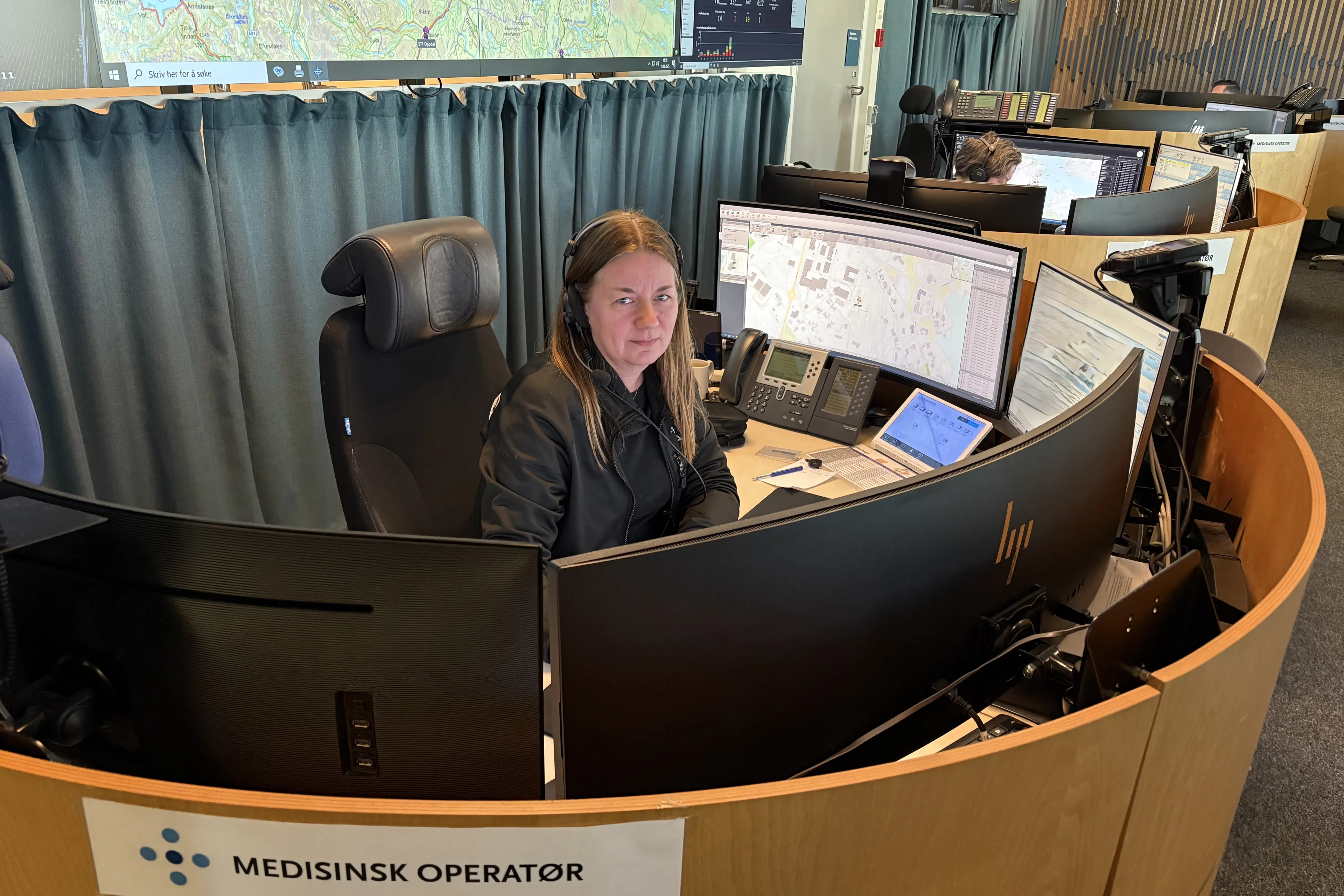
The first person you encounter when you call 113 is the medical operator at the AMK centre.

In Norway, we have a two-part emergency service.

  • If you need urgent medical assistance, you call 113 and the emergency medical communication centre (AMK centre) will respond.
  • If you need immediate help, you call 116117 and the out-of-hours medical service will respond.

The main function of these two centres is to determine exactly what kind of help you need.

Sometimes it may be advice and guidance over the phone or via video, while other times it may involve a combination of a doctor’s car, ambulance, ambulance boat, air ambulance, or air ambulance service.

Medisinsk operatør Trine  ved AMK-sentralen

Medical operator Trine Horven at the AMK centre at St. Olav's Hospital is committed to addressing all callers with professional confidence, respect, and care.

It is the medical operators at the AMK centres who determine what help and resources you need when you call 113, and it is the AMK centres that coordinate all ambulance missions.
To ambulansepersonell sitter i døra på en ambulansebil
At the ambulance station in Rosten, Trondheim, paramedic Ulf Rytter and second-year apprentice Elena Bjørndal Johansen are working.
For Elena, working in the ambulance has been her dream job for many years. Eventually, she took the leap, managed to get onto the course, and secured an apprenticeship. - It is a tough job with a lot to go through. The best part of the job is that you learn something new all the time, and that it is demanding both physically and mentally.
Elena is on her way out to yet another patient who needs help quickly. St. Olav's Hospital has 32 ambulances in operation.

To provide appropriate and equal assistance to all callers, the AMK centres use the Norwegian Index for Medical Emergency Assistance. This is a tool and a list of various situations and criteria divided into three categories: Acute, urgent, or routine.

In addition to ensuring that help is on the way, the operator aims to gather necessary information about the incident and the patient to provide the best possible assistance. For each situation, information cards have been prepared that describe what the operator should ask about, provide guidance on, and what assistance should be initiated.

In the vast majority of acute and urgent cases, an ambulance is dispatched to assist the patient.

In 2023, there were 325,000 emergency missions involving ambulances in Norway (Source: SSB).

A person holding a baby

Ambulance personnel can come right into your home with advanced medical equipment if you need it.

Here, Elena is checking the ECG (electrocardiogram) on a man with breathing difficulties.

A couple of people in red jumpsuits standing in a room
The patient is taken to the accident and emergency department at St. Olav's Hospital. Ulf and Elena make several visits there during a shift, but they also visit the out-of-hours service and the patients' general practitioners if that is the appropriate place for treatment.
A person sitting at a desk with several monitors

A few floors up in the AMK centre, they have received a patient assignment that requires a helicopter. Air ambulance coordinator Håvard Lund is tasked with notifying the crew of the ambulance helicopter in Trondheim.

The air ambulance coordinator (LA coordinator) is responsible for notifying the crew at the helicopter base and coordinating the mission with collaborating resources.

Another very important task is to obtain the flight route and estimated landing time, record the number of people on board during all helicopter movements, and implement necessary measures if contact with the helicopter is lost.

We currently have four AMK centres with LA coordinators in Norway:

  • St. Olav's Hospital (Trondheim)
  • Haukeland University Hospital (Bergen)
  • University Hospital of Northern Norway (Tromsø)
  • Oslo University Hospital (Oslo)

Lege, redningsmann og pilot  foran helikopter
At the helicopter base in Trondheim, anaesthetist Oddvar Uleberg, pilot Andreas Eriksen, and rescue man Peder Gartland are on duty this day.

When the helicopter crew is not on a mission, they often practise. Here are rescue worker Peder, pilot Andreas, and doctor Oddvar fully engaged in practising what to do with a baby who is not breathing.

Air ambulance can be used in cases of serious illness or injury that require rapid and/or specialised monitoring, emergency medical treatment, and transport. Air ambulance can also be used in situations where the distance is so great that it becomes a burden for the patient to be transported by car or boat, or where the patient is located in areas that are difficult to access for land-based resources.
Bakre del av ambulansefly foran himmel og fjell

Air ambulances can be used for the transfer of patients where air transport is necessary based on a medical assessment.

While helicopters are the resource most frequently used for missions transporting patients from home or the scene of an accident to hospital, air ambulances have the most missions transferring patients from smaller to larger hospitals, returning them to their local hospital, as well as for specialised transports.

Air ambulances in Northern Norway have far more emergency missions than in Southern Norway. When air ambulances are used for primary missions in the north, the urgency is often high. The largest proportion of these missions occurs in Finnmark.

Back in Trondheim, the helicopter crew has received an urgent mission. A patient is showing symptoms of a stroke, and it is critical to get them to hospital quickly. The patient has been picked up from their home by a road ambulance, which is already en route to meet the helicopter.
In just a few minutes, the crew is in the air and on their way to the patient. Doctor Oddvar Uleberg checks the latest information he has received from the air ambulance coordinator.

Air ambulance missions in 2024

17115 mission

Ambulance missions with helicopter, plane, and rescue helicopter

A yellow helicopter on a road
The ambulance that has picked up the patient is ready at the agreed meeting point, and the patient is quickly transferred into the helicopter.
Lege med pasient i helikopter
Inside the helicopter, Oddvar checks on how the patient is doing and closely monitors the patient throughout the entire journey to the hospital.
A significant quality element in the Norwegian air ambulance service is the high level of medical expertise on board. These are doctors and nurses who also work in the anaesthesia and intensive care departments of hospitals and can therefore provide advanced medical treatment before and during transport. In addition, all rescue personnel on the ambulance and rescue helicopters have a nursing or ambulance background. Our air ambulances are equipped with highly advanced medical equipment and function like a flying intensive care unit in a hospital.
Lege og redningsmann med båre på helipad. Helikopter ved siden av.
The helicopter lands on the roof of St. Olav's Hospital and the patient is escorted inside by the helicopter crew to the waiting stroke team.

In the event of a suspected stroke, treatment begins in the ambulance. Intravenous fluids are usually administered to improve blood circulation to the brain, and oxygen is provided via a nasal cannula to ensure adequate oxygen supply to the brain, which may have reduced blood flow if oxygen saturation is too low.

Upon arrival at the emergency department, a neurological examination, blood pressure measurement, pulse check, ECG, blood sampling, and imaging of the brain using CT are carried out immediately.

A group of people in a room
Just a few minutes after the patient has landed on the roof of St. Olav's Hospital, he is lifted into the CT scanner, which takes images. The imaging examination clarifies whether there is bleeding or infarction and whether the blood vessels in the brain are open.
A review of the base structure for the air ambulance service in 2020 shows that approximately 99 per cent of the population can now be reached by doctor-staffed air ambulance within 45 minutes.
Parliamentary Report 23 (2024-25): Renew, Strengthen, Improve
Together, we ensure that you receive prompt assistance when it is most urgent.